Essential Rights the California Paternity Leave Laws Provide Working Parents
Studies say that over 6 out of 10 men in the US are fathers, and more than 10,000 babies grace this planet with their arrival every single day. But almost 65% of American men are working as well, and understanding their California employee rights is more important than ever. Do California paternity leave laws allow these men to spend time with their newborns?
Becoming a dad is a big deal… for the dad, the mom, and of course, the baby in question! We have studies stating how fathers create strong bonds with their babies via skin-to-skin contact. This skin-to-skin contact doesn’t lie in the realm of possibilities unless you take your newborn to work or get a few weeks off to focus on the family you’ve just started. So, which one is it?
Fatherhood is a magical thing. Many of us can understand what it feels like to become a parent for the first time; it’s not rainbows and unicorns all the time. You have to be there for those first feeds, diaper changes, late-night cuddles, and whatnot. Instead of stressing over sales calls & work emails. That’s where being a Californian really pays. The Golden State leads the nation when it comes to strong family leave protections and other benefits for working parents.
Here’s the simple truth about paternity leave: you can get up to 12 weeks off work without pay (mostly), but your job will be there when you come back after 3 months. If you apply for PFL benefits, you can stay with your baby for 8 weeks (at max) with partial pay.The Golden State has increased this partial pay from the previous cap of 60%; workers can now get between 70% and 90% upon welcoming a baby into the family. Let’s see the details.
What California Paternity Leave Laws Mean
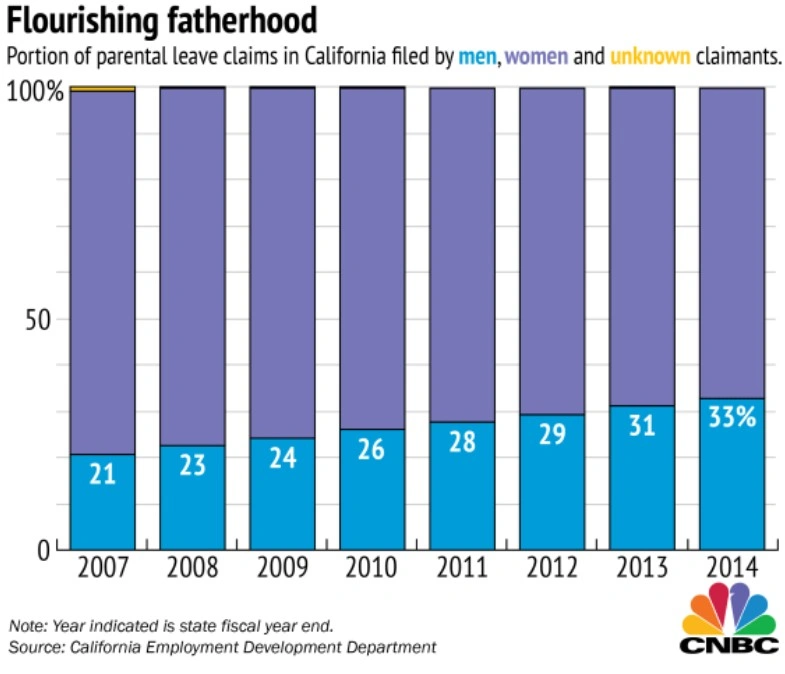
The graph you can see above shows that the portion of men filing parental leave claims in the Golden State went from barely over 21% in 2007 to a whopping 33% in 2014. It means that a third of these claims were coming from dads 12 years ago. When we talk about an employee’s rights in California, we discuss problems like prevailing wages and overtime. But the question of dads taking time off work to focus on their newborns is not very hotly debated, it seems.
New dads in California have a solid option to take time off work. If you welcome a new child into your family, you may get a few weeks off. But that doesn’t mean you’re guaranteed your normal salary when you’re spending all of your time at home. You have to look into the depths of these California paternity leave laws to understand your rights regarding your growing family.
Understanding the Core Laws Driving Paternity Leave
We already gave you a brief overview of the two laws governing your paternity leave.
- One of them is called the California Family Rights Act (CFRA). It protects your job when you’re overjoyed by the birth of a child so much that you simply can’t be made to come back to work. You’ll get 12 weeks (at max) of unpaid leave so you can spend some time with your babe. CFRA’s sole focus is your job security. Your employer can’t fire you when you’re away (if they do end up firing you, they have to give you a job when you return).
- The second one’s an even more generous law. We call it Paid Family Leave (PFL), and it runs through the Employment Development Department (EDD). PDF covers part of your wages when you’re away, letting dads take meaningful time to be present for those early days of childhood development. You may also get up to 90% of your salary for the next 8 weeks. If you get fired when you’re away, you may sue your company for discrimination.
Why Dads Get Equal Treatment
Did you know that the number of Californian fathers taking paid family leave to bond with a new child increased by 20% since the beginning of the pandemic? The Golden State has ditched the old “maternity-only” ideas in favor of recognizing that both parents have the right to spend time with their kid. Dads not getting equal treatment can file a claim against their employer, the same way Jones Day workers, Julia Sheketoff and Mark Savignac, did in 2024.
What Makes You Qualify for CFRA Job Protection
- Employer Coverage Threshold: You should start praying that your company has at least 5 employees within 75 miles of your workplace. That’s when you qualify for the CFRA-approved 12 weeks. FMLA protections become applicable when you work for a company employing 50 individuals. But if you have a public employer, you have the golden ticket, since you’ll always qualify without size limits bothering you.
- Service & Hours Requirements: If you’re working for your current employer for 12 months before asking for your paternity leave, you’ve got it. Even part-time workdays count here. Overtime also counts here (not unpaid breaks).
- Qualifying Family Events: Bonding with a newborn doesn’t necessarily mean the kid came out of the womb; adopting a child aged less than 5 via adoption also works. Kids from foster care also make you eligible for paternity leave. Grandkids don’t! Similarly, if a kid has been placed into your care via non-legal means, you’re eligible for leave.
- Protections: CFRA ensures that your job will be there when you come back from work. PFL benefits guarantee partial pay as well. Your boss can’t demote you simply because you chose your family over work (firing you would be retaliation). If you wish to use this leave intermittently, you need to give notice to your company.
Who Might Not Qualify Right Away
- You can’t join a company yesterday and then ask for paternity leave tomorrow.
- Tiny shops with fewer than 5 people can legally refuse to honor the CFRA job protection.
- Gig workers or freelancers lack CFRA coverage as well, so they can’t expect their boss to keep their roles vacant for 12 weeks.
Paid Family Leave (or Getting Cash While You’re Away)
We already mentioned what PFL is in a previous section. But just like our readers need to read how many hours are overtime again and again to understand this concept, PFL should be repeated here so you can help you understand how these benefits help you spend quality time with kids.
PFL turns the tables on CFRA job protections by making sure that your unpaid bonding time is something you can actually afford. This state insurance program steps in when Californian dads are blessed with kids, offering partial wage replacement so you don’t go broke while you’re busy changing nappies while missing work. PFL benefits are your rights as a Californian!
Strong California paternity leave laws make sure you get your PFL benefits because you are already paying into it through small paycheck deductions. Check your pay stubs for those SDI or CASDI deductions. That tells you your funding score. So, how does PFL benefit you?
How PFL Benefits Workers in 2026
We said earlier that Californian workers used to get 60% of their income via PFL benefits upon getting a new kid. But the new laws have updated these benefits. You can now get up to 90% of your usual income when you’re busy taking care of and bonding with your spawn for the next 8 weeks (2 months).
- Lower earners can get closer to 90% than Icarus to the Sun
- Higher ones can make it around 70% (based on how much they’re already making)
It’s not guesswork. The EDD uses a formula here that adjusts each year for inflation. You can get a weekly benefit of $1,620 to $1,765 (for the next 8 weeks). It’s not full pay. But it beats scraping by on savings.
Applying for Paternity Leave in California
There was a case of a Disney actor on the Lion King tour (a Mufasa understudy) who was fired on the first day of his paternity leave. He sued Disney for discrimination. Yes, if your boss ends up firing you for taking time off work to bond with your newborn, you have the right to sue.
But how do you even apply for PFL benefits? Whether you’re based in Los Angeles or anywhere else in California, you can apply for paternity leave at edd.ca.gov or send your application by mail (there’s no need for employer sign-off in these cases).
- Your application can’t make a solo journey; it has to be accompanied by your newborn’s birth certificate, your ID, pay stubs from the last 18 months, etc.
- Make sure your SDI earnings have more than $300
- You should file a claim within 41 days of starting your leave (expect your first payment in 1 to 2 weeks via debit card or direct deposit)
- It’s not like medical leaves, where you need a doctor’s note (a simple bonding form would suffice)
- You can track your application’s status on EDD and then extend your leave up to a year from childbirth
How to Stack PFL with CFRA and Limits
If you want to stack PFFL with CFRA, you can pair PFL’s eight paid weeks with CFRA’s twelve job-protected weeks for maximum impact. You can take paid first and then unpaid after. There is a rule that says one parent per couple if both you and your spouse are using CFRA. The best thing is to coordinate so you can max out these benefits (don’t forget the 12-month window from childbirth/adoption). That’s how you can use both leave types to maximize your benefit.
How Sneaky Employers Might Try to Dodge You
Your boss can’t block your PFL benefits. This state-run program runs without the intervention of your employer. Your boss can pressure you by saying Use PTO only or ask you to delay your notice. These actions are illegal. Our team at Rio Law can ensure California paternity leave laws are being properly applied, so your employer doesn’t try to dodge you.
A lawsuit was filed in Ventura County last year in which Mark Perryman, Supervisor Jeff Gorell’s chief of staff, accused the county of firing him for his paternity leave request. That’s why it’s vital that you understand how these things work before you apply for your leave.
- One parent per couple (if both work for CFRA-covered employers and coordinate)
- You get a 12-month window from the birth or adoption of your kid
- There’s no carryover beyond one year
Answering 4 Myths about California Paternity Leave Laws
- Paternity Leave is Just for Moms
Even some employees have misconceptions regarding paternity leave. They believe that only a mother can get paid leave after giving birth to a child. These notions are outdated. We’re living in modern times when dads shouldn’t face discrimination when they’re trying to spend quality time with their kids. Biological fathers aren’t the only ones; adoptive dads, foster parents, and same-sex partners fully qualify as well.
- Paternity Leave is Fully Paid
We believe we have explained it properly that not every paternity leave type is paid in full. If you apply for CFRA benefits, your job stays protected, and you can’t get fired. PFL benefits make sure that you are getting 70% to 90% of your usual salary when you’re off work.
- Small Companies Don’t Have to Offer It
Don’t let fears like “we’re too small” stop you from applying for paternity leave. CFRA kicks in when your company has 5 employees. The New Parent Leave Act (NPLA) steps up to help & support you when you’re working for an even smaller company.
- Your Boss Decides How Long You Can Take
When your boss tells you, “We need you back ASAP,” that’s a red flag. Your boss can’t decide when your paternity leave should begin. It’s up to you… and you alone! Your boss has no right to shorten your paternity leave.
Hire Rio Law to Defend Your Rights
You can see that California paternity leave laws make sure you get 12 weeks off work without getting paid. But applying for PFL benefits will give you 8 weeks away from work while you also get up to 90% of your usual salary during all this time. We at Rio Law will help you make sense of all this. Get in touch with us if you want to apply for paternity leave but are getting problems with your employer. We’ll give you the best representation possible in California.







 Call
Call